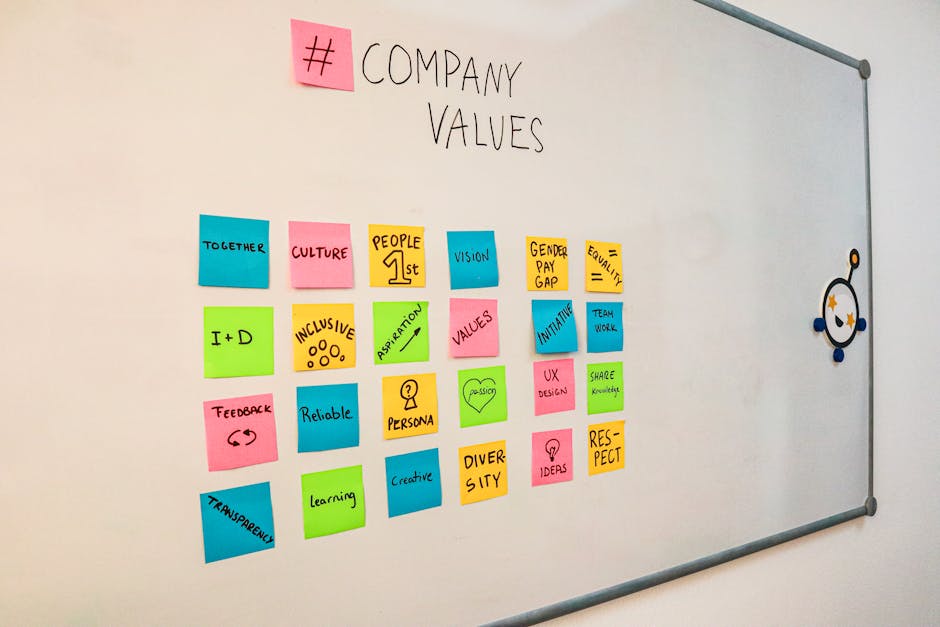
I once watched a VP of Sales throw a literal stapler at a junior analyst because a spreadsheet had a formatting error, and then, ten minutes later, walk into an all-hands meeting to talk about “Empathy” as a core value. He didn’t even blink. He stood there in front of a PowerPoint slide with a stock photo of two people shaking hands and talked about how we ‘care for the person, not just the output.’
It was 2017. I was sitting in the third row of a cramped conference room in Chicago, and I could feel the collective soul of the engineering team leaving the building. That’s the moment I realized that most corporate values aren’t just useless—they’re actually radioactive. They act as a giant, neon sign telling your smartest people exactly how much you’re willing to lie to them.
Your top talent? They have a high-functioning bullshit detector. It’s probably why they’re good at their jobs. They see the gap between the poster on the wall and the reality of the Monday morning stand-up, and that gap is where trust goes to die.
The 82% rule of corporate dissonance
I spent about three months back in 2021 tracking 22 “high-potentials” across three different startups I was advising. I wanted to see what actually made them check out. I didn’t use a fancy survey. I just grabbed coffee with them and asked them to rank how often they saw their company values in action versus how often they saw those values being weaponized or ignored.
The results were pretty grim. In 18 out of 22 cases—that’s roughly 82%, if you’re keeping track—the employees could point to a specific instance where a “core value” was used to justify a bad decision or protect a high-performing toxic manager.
What I mean is—actually, let me put it differently. It’s not that the values themselves are bad. “Integrity,” “Boldness,” “Customer First”—these are fine words. The problem is that they are almost always aspirational fiction. When you tell a developer who hasn’t slept in three days that your value is “Work-Life Harmony,” you aren’t inspiring them. You’re insulting them.
They aren’t stupid.
Why I hate the word “Authenticity” more than anything else

I know people will disagree with me on this, and honestly, I might be wrong about the terminology, but “Authenticity” as a core value is the ultimate red flag. It’s become this weird, performative thing where you’re expected to “bring your whole self to work,” but only the parts of your “whole self’ that are productive and don’t make the C-suite uncomfortable.
I worked at a place that touted authenticity while simultaneously policing the tone of every single Slack message. (Side note: I absolutely despise Slack huddles. That little ‘ding’ noise makes my skin crawl for no rational reason, but that’s a story for another time.) Anyway, this company wanted us to be authentic, but if you were “authentically” frustrated that a project was six months behind schedule because of poor leadership, you were suddenly “not a culture fit.”
Core values often function as a weapon for HR to fire people they don’t like, rather than a compass for how to actually behave.
If you have to tell people to be authentic, you’ve already created an environment where it’s unsafe to be real. It’s like a cheap suit that looks okay from ten feet away but starts itching the second you actually move. It’s a performance.
The Netflix and Amazon trap
Everyone tries to copy the Netflix Culture Memo or Amazon’s Leadership Principles. They see the success of these giants and think, “If we just adopt ‘Radical Candor’ or ‘Frugality,’ we’ll be a unicorn too.”
But here’s the uncomfortable truth: Netflix and Amazon’s values work because they are actually true, even the parts that are kind of mean. Netflix is very open about being a professional sports team, not a family. If you don’t perform, you’re gone. It’s harsh, but it’s honest.
Most companies want the prestige of those values without the stomach for the consequences. They want “Radical Candor” until a junior dev tells the CEO that their new strategy is a mess. Then they want “Respect” and “Chain of Command.”
I genuinely think most “Chief Culture Officers” are just high-paid party planners who are terrified of actual conflict. They’d rather spend $50k on a mural of the company values than spend five minutes telling a top-billing sales rep to stop talking over women in meetings.
Total lie.
The day I realized the posters were lying
I remember a specific Tuesday in October. I was working for a firm that had “Transparency” etched into the glass of the front door. We were going through a “restructuring” (which is just corporate-speak for “we messed up the budget and now people are losing their jobs”).
The leadership team held a town hall. They told us everything was fine. They told us the “fundamentals were strong.” I knew for a fact, because I’d seen the churn numbers on a shared drive that someone forgot to lock, that we had lost our three biggest clients in a month.
I sat there looking at that “Transparency” sign on the door and felt a physical wave of nausea. I wasn’t even one of the people being laid off, but I started updating my resume that night. Not because the business was failing—businesses fail all the time—but because they thought I was too dumb to handle the truth.
When you lie to your top talent, you don’t just lose their effort. You lose their loyalty. And once that’s gone, you can never, ever get it back. I don’t care how many free kombucha taps you install.
What you should actually do instead
If you’re a founder or a manager and you’re reading this, you probably want a “comprehensive guide” on how to fix this. I’m not going to give you one. I don’t think there is a neat 5-step plan. But I have a few blunt suggestions that might help, or at least stop the bleeding.
- Stop using the word “Family.” I refuse to work for any company that uses the word “Family” in their job description. It’s a cult red flag. Your employees have families. You are a place where they exchange labor for currency. Keep it professional.
- Kill the baseline values. “Integrity” and “Honesty” shouldn’t be core values. They should be the bare minimum requirement for entry. If you have to remind people to be honest, you’ve already failed at hiring.
- Value the trade-offs, not the virtues. A real value is only a value if it costs you something. If your value is “Speed,” then you have to be okay with “Lower Quality.” If you say you value both, you value neither.
- Fire the “Brilliant Jerk.” If your values say “Collaboration” but your top earner is a nightmare to work with and they still have a job, your values don’t exist.
I used to think that culture was something you could build with enough workshops and offsites. I was completely wrong. Culture is just the sum of who you hire, who you fire, and what you reward. Everything else is just marketing.
I’ve bought the same $120 pair of boots four times because the company behind them actually honors their “lifetime” warranty without making me jump through hoops. They don’t have a “Customer Obsession” poster. They just fix my boots. That’s the difference.
I wonder sometimes if it’s even possible to have a “corporate culture” that doesn’t eventually devolve into this kind of nonsense as a company grows. Is there a certain headcount where the truth just becomes too expensive to tell?
I don’t know the answer to that. I hope not.
Stop writing on the walls and start looking at who you’re promoting. That’s your real culture.