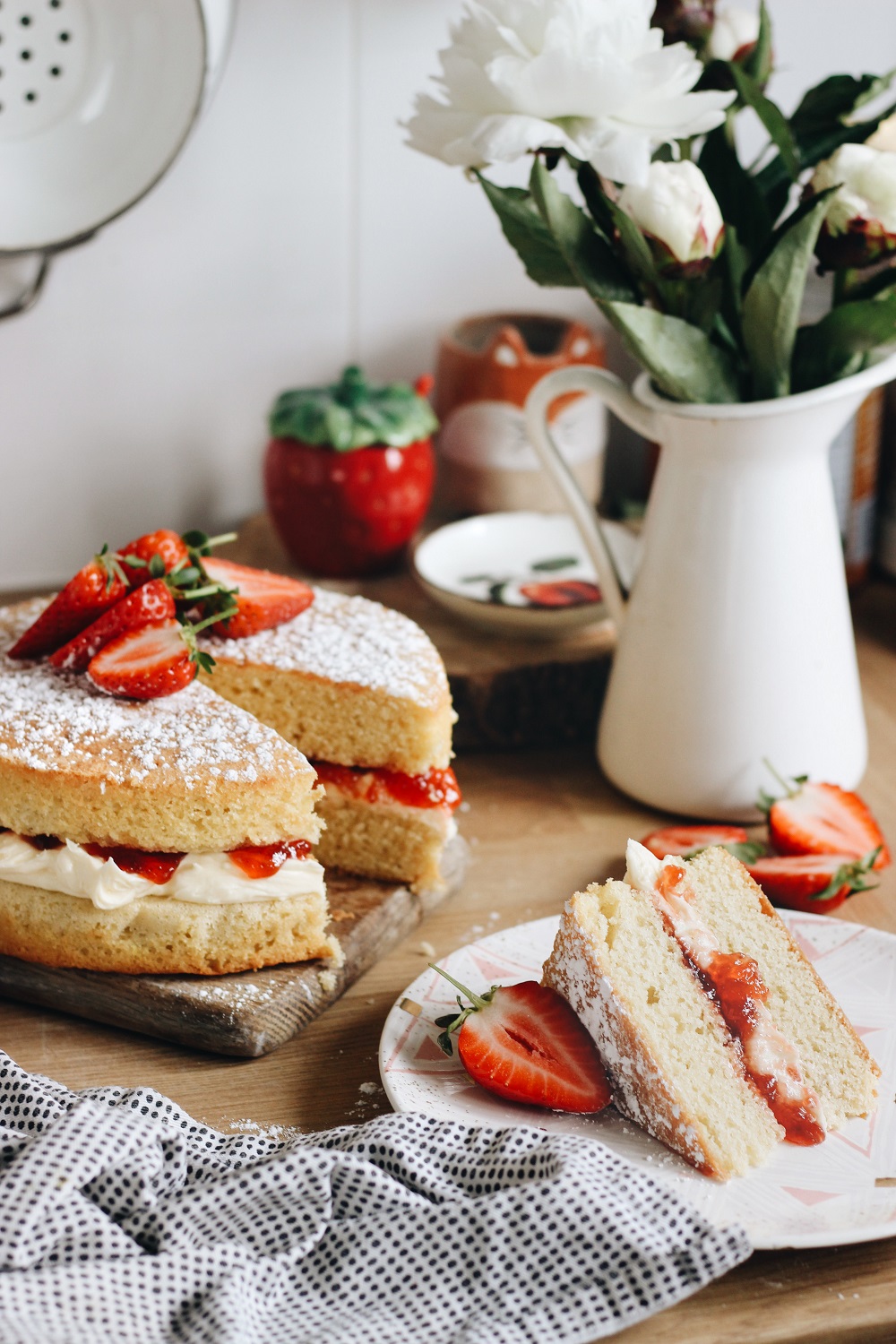
Most home bakers blame their oven when a Victoria sponge collapses. The oven is rarely the actual problem.
The real issue is almost always the ratio — or a specific step that got shortchanged. A Victoria sponge runs on one of the most reliable formulas in baking: equal weights of butter, sugar, eggs, and flour. When that formula gets compromised — through imprecise measuring, under-creaming, wrong tin size, or baking powder sitting open since last Christmas — the cake fails. Predictably. Every time.
Every one of these failures is diagnosable and preventable. The formula is not magic. It is math.
What Equal Weights Actually Means (and Why Most Recipes Get It Wrong)
The equal-weight method is the backbone of this cake. Here is what the shorthand version leaves out: you weigh your eggs first, then match everything else to that number.
Three large eggs typically weigh between 160g and 185g total, depending on breed, season, and farm. That means your recipe uses 160–185g of butter, 160–185g of caster sugar, and 160–185g of flour — not a fixed 170g regardless of what your eggs actually weigh. When a recipe says three eggs and six ounces of everything else, it is assuming eggs that match that weight. They often do not.
A UK large egg and a US large egg are not standardized to the same weight. UK large eggs run 63–73g each. US large eggs run 50–57g. Use a British recipe with American eggs without weighing anything and your ratios are already wrong before the oven is on.
The Self-Raising Flour Problem Nobody Talks About
Self-raising flour has a shelf life problem most home bakers ignore. Baking powder degrades over time — and faster once the bag is open. A bag open for four months has significantly less lift than the label promises.
After 8–12 months of opening, the raising agent performs at under 50% capacity. Your cake looks technically correct going into the oven, then fails to rise and forms a dense, gummy centre. The fix: plain flour plus 2 teaspoons of fresh baking powder per 200g. You control the freshness. A new tin of baking powder costs under $2. Cheap coverage against a pointless failure.
Butter Temperature: The Exact Number That Ends the Argument
Room temperature butter means 18–20°C. Not been out an hour. Not soft enough to dent with your finger. Eighteen to twenty degrees Celsius, verified.
Below 16°C, butter clumps rather than creams — the mixer moves it around instead of incorporating air into it. Above 23°C, butter starts melting into the sugar instead of trapping air alongside it. Both failures produce a flat cake for different reasons. A digital kitchen thermometer costs $8–$15. The data point it gives you is worth more than following a dozen recipe tips.
The Six Failure Modes Behind Every Bad Victoria Sponge
Every flat, sunken, rubbery, or raw-middled Victoria sponge traces to one of these six errors. Think of them as the exclusion clauses in the recipe — all written into the method, but easy to skim past.
- Under-creamed butter and sugar. Four minutes minimum on medium-high speed. If the mixture is not pale — almost white — and fluffy after four minutes, give it two more. The air trapped here is the structural foundation for the entire cake. Rush it and nothing downstream fixes the result.
- Cold butter. Butter below 16°C does not cream — it breaks into clumps that never incorporate properly. If you forgot to take it out ahead of time, grate it coarsely on a box grater and spread the shreds on a plate. They reach 18–20°C in around 10–12 minutes at typical kitchen temperature.
- Opening the oven door before 15 minutes. Before the protein structure in the batter has set, opening the oven drops internal temperature sharply. The rising cake collapses because it has no rigid structure yet to hold its own height. Set a timer. Leave the oven alone until at least the 15-minute mark.
- Old or degraded baking powder. Test it before using: drop 1 teaspoon into hot water. Vigorous immediate fizzing means it is active. Weak or no fizzing means replace it. A tin opened more than 6 months ago is borderline. A tin opened more than 12 months ago is effectively inert.
- Wrong tin size. A 23cm (9-inch) tin for a recipe designed for 20cm (8-inch) gives you a thin, wide batter layer that overbakes at the edges before the centre sets. Dry-edged cake, underdone middle. Tin size is not flexible.
- Filling a warm cake. A sponge that is not fully cooled absorbs whipped cream and softens under jam. Minimum cooling time: 45 minutes on a wire rack, or until the bottom of the tin is cool to the touch throughout. Non-negotiable.
Results vary by oven type, altitude, and ingredient quality — but these six failure modes account for the vast majority of Victoria sponge disasters across all conditions. Fixing them covers more ground than any recipe tweak.
Ingredient Comparison: What to Buy and What to Skip
Not all ingredients perform equally in this recipe. The table below breaks down the most common choices by category, with specific brand picks and notes on what actually separates them.
| Ingredient | Top Pick | Acceptable Alternative | Avoid | Why the Difference Matters |
|---|---|---|---|---|
| Butter | Président Unsalted (82% fat) | Anchor Unsalted (80% fat) | Spreadable, margarine, or salted | Higher fat content means less water in the batter and a more tender crumb. Salted butter affects browning unpredictably. |
| Sugar | Billington’s Golden Caster Sugar | Standard white caster sugar | Granulated or icing sugar | Finer crystal size enables faster, more even creaming. Granulated leaves undissolved grains that create a gritty texture. |
| Flour | Plain flour + fresh baking powder | Self-raising (opened under 2 months) | Old self-raising (opened over 6 months) | Degraded leavener means no lift. Controlling freshness yourself removes the variable entirely. |
| Eggs | Free-range large, weighed | Standard large, weighed | Medium eggs without ratio adjustment | Weight drives all other measurements. Unweighed eggs mean uncontrolled ratios. |
| Vanilla | Nielsen-Massey Pure Vanilla Extract ($12/60ml) | Good-quality vanilla bean paste | Imitation vanilla flavoring | Synthetic coumarin derivatives in imitation vanilla produce a flat, slightly chemical aftertaste at baking temperatures. |
| Jam | Bonne Maman Strawberry Conserve (~$4.50/370g) | Wilkin & Sons Tiptree Strawberry (~$5/340g) | Budget store jam with high water content | Watery jam soaks into the sponge and creates a soggy layer within 1–2 hours of assembly. |
The butter pick is the clearest call. Président Unsalted at 82% fat consistently outperforms lower-fat options on crumb texture — higher fat means proportionally less water in the batter, which translates directly to tenderness. Anchor Unsalted (80% fat) is a reliable second choice and easier to find in most North American grocery stores.
On jam: Bonne Maman Strawberry Conserve has one of the highest fruit-to-water ratios among mainstream conserves. Watery jam does not just soak the sponge — it causes the layers to slide when the cake is cut. The price difference between premium conserve and budget jam is about $2. That is not where to economize.
The Recipe: Exact Measurements and Method
This recipe scales to your eggs. Weigh them first, then match every other ingredient to that number.
Equipment
Two 20cm (8-inch) round sandwich tins, at least 4cm deep, greased and lined with parchment. Do not use springform tins — the loose base allows batter to seep and distributes heat unevenly.
A stand mixer gives the most consistent results. The KitchenAid Artisan Series (4.8L bowl, ~$400) and the Kenwood Chef Titanium (6.7L bowl, ~$300) are the two most reliable options for home baking. Both have paddle attachments that cream butter efficiently without overworking the batter once flour is added. The Breville Hand Mixer ($35–$60) handles this recipe well — you just have to watch timing more carefully. An oven thermometer ($8–$15) matters more than which mixer you own: domestic ovens typically run 15–25°C off their stated temperature.
Ingredients (scaled to approximately 165g eggs)
- 3 large free-range eggs, weighed (target ~165g total)
- 165g unsalted butter (Président or Anchor), at 18–20°C
- 165g Billington’s Golden Caster Sugar
- 165g plain flour, sifted
- 1½ tsp fresh baking powder
- ½ tsp Nielsen-Massey Pure Vanilla Extract
- 1–2 tbsp whole milk, if needed
Method
- Preheat to 180°C fan / 200°C conventional / 400°F. Verify with an oven thermometer. If your oven runs hot by 15°C or more, reduce the stated temperature accordingly before baking.
- Beat butter and sugar for 4–5 minutes until genuinely pale and fluffy. Stop and scrape down the bowl at the 2-minute mark. The mixture should be noticeably lighter in colour by the end — not just combined.
- Add eggs one at a time, beating well after each. If the batter looks curdled after the second egg, add 1 tablespoon of flour and beat briefly before continuing with the third.
- Fold in flour, baking powder, and vanilla with a large metal spoon or rubber spatula. Target 20–25 folds — stop the moment you can no longer see streaks of flour.
- Check batter consistency: it should fall off a spoon in about 3 seconds. Falls immediately means too loose — add a tablespoon more flour. Does not move at all means add milk one tablespoon at a time.
- Divide evenly between tins using a kitchen scale. Even weight equals even baking.
- Bake 20–22 minutes. The cake pulls away from the tin edges slightly when done, and a skewer inserted in the centre comes out clean.
- Cool in tins for 5 minutes, then turn onto a wire rack. Cool completely — minimum 45 minutes — before adding any filling.
Filling Options: Stability and Serving Window Compared
What is the most traditional filling?
Strawberry jam and whipped double cream, in that order: jam on the bottom layer, cream spread over it before the top sponge goes down. Whip the cream to soft peaks only — not stiff. Stiff whipped cream tears the sponge when you place the top layer and does not compress evenly when cut. Use 150ml of double cream at 35%+ fat. This is the lightest, most traditional result but carries a 2–3 hour serving window before the cream begins weeping into the sponge.
What if I need to make the cake ahead?
Vanilla buttercream. Beat 100g of Président Unsalted Butter until pale, gradually add 200g of icing sugar, and finish with half a teaspoon of vanilla extract. Structurally stable refrigerated for 24 hours. Remove the assembled cake 30 minutes before serving — buttercream firms in the cold but returns to a soft texture at room temperature. For events where the cake needs to sit out for a few hours, buttercream is the highest-reliability coverage.
Is there a more interesting modern alternative?
Philadelphia Full-Fat Cream Cheese beaten with 50g icing sugar and the zest of one lemon. Pair it with raspberry jam rather than strawberry — raspberry’s tartness works better against the cream cheese tang. Do not use reduced-fat Philadelphia. Lower-fat versions contain more water and the filling goes slack within an hour. Full-fat holds for about 8 hours refrigerated before layers soften significantly.
Rodda’s Cornish Clotted Cream ($6–8 per jar) is the most stable option at cool room temperature. It does not whip and does not weep. The texture is dense and very rich — a thin layer goes further than expected. For an afternoon tea where the cake sits out for several hours, this is the best-performing filling.
| Filling | Brand Pick | Serving Window | Stability | Best For |
|---|---|---|---|---|
| Whipped Double Cream | Any 35%+ fat double cream | 2–3 hours | Low (weeps) | Same-day serving, immediate use |
| Clotted Cream | Rodda’s Cornish Clotted Cream | 4–6 hours | Medium-High | Afternoon tea, cool room temperature |
| Vanilla Buttercream | Président Unsalted + icing sugar | 24 hours refrigerated | High | Make-ahead baking, events |
| Cream Cheese + Lemon | Philadelphia Full-Fat | 8 hours refrigerated | Medium | Modern variation, pairs with raspberry jam |
Each filling has a different risk profile. Whipped cream is the most traditional and the most time-sensitive. Buttercream is the safest choice for anyone assembling more than 2 hours ahead. Clotted cream sits between them — flavorful, stable at cool temperatures, and classically correct for a traditional presentation.
For a first-time bake where you want maximum control: buttercream filling, Bonne Maman jam, and a verified oven temperature. Those three decisions remove most of the variables that turn a reliable recipe into a frustrating result.